
The EPS Production Line: Machine by Machine
An EPS (Expanded Polystyrene) factory is built around a sequence of core machines, each handling a distinct stage of the transformation from raw polystyrene beads to finished foam products. This guide follows the process in order, covering every piece of equipment you will encounter on a production floor.
1. Pre-Expander
The pre-expander is the first machine in the line. Raw EPS beads (small, hard polystyrene granules containing 4-7% pentane as a blowing agent) are fed into a heated chamber where steam at 0.3-0.6 bar gauge causes them to expand. The beads can grow to 20-50 times their original volume depending on the target density, which typically ranges from 10 to 40 kg/m3.
There are two main types:
- Batch pre-expanders process a fixed charge of material per cycle. They offer precise density control, making them the standard choice for most factories. Capacities range from 100 to 2,000 kg/hour depending on the model and target density.
- Continuous pre-expanders run without stopping, feeding beads through the steam zone on a continuous basis. These are used in very high-throughput installations but require more careful tuning.
Modern pre-expanders include automatic density controllers that weigh a sample after each batch and adjust steam time or feed quantity to maintain the setpoint. This feedback loop is critical for consistent output.
2. Aging Silos (Maturation Silos)
After pre-expansion, the beads are pneumatically conveyed to large fabric or mesh silos where they rest for 6 to 24 hours. During this curing period, three things happen:
- Residual moisture from steam exposure evaporates.
- Air diffuses into the cells to replace the condensed pentane and water vapor, restoring internal pressure.
- The beads reach a stable, uniform condition suitable for molding.
A typical factory will have 10 to 30 silos, each holding 2 to 10 m3, to buffer production between the pre-expansion and molding stages. Adequate ventilation around the silos is mandatory to disperse any pentane released during aging.
3. Block Molding Machine
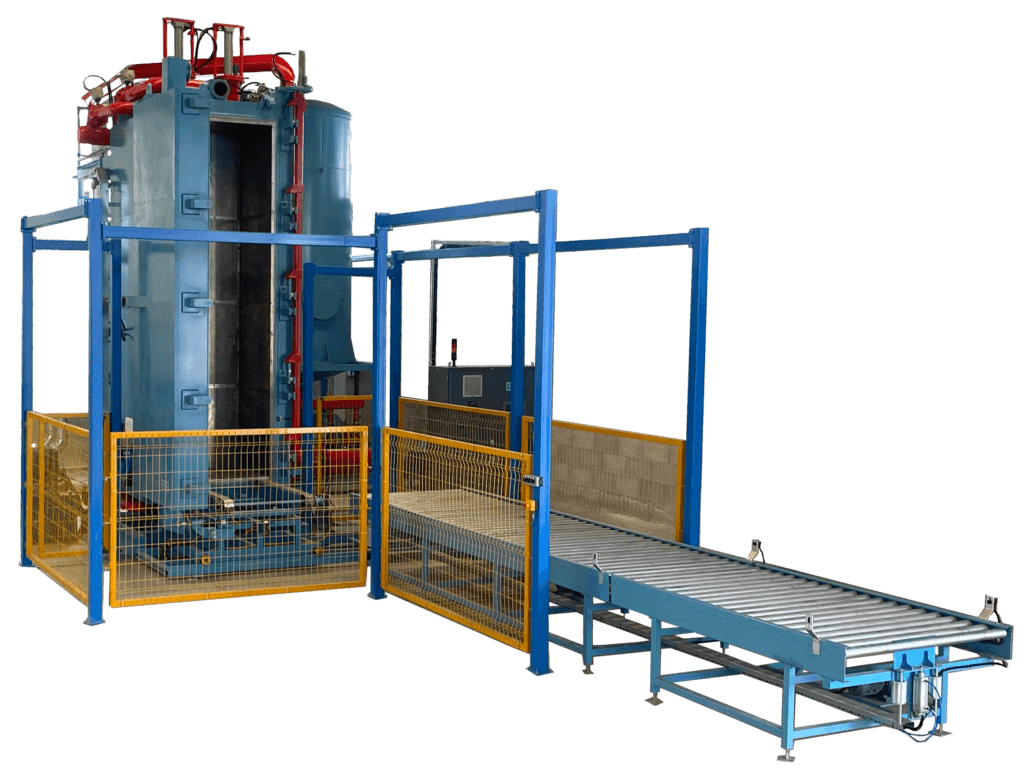
The block mold produces large rectangular EPS blocks. Common dimensions are 1,000 x 1,250 x 5,000 mm, though machines with adjustable walls can vary the block width and length. Aged beads are blown into the mold cavity, then steam is injected through perforated plates at 0.4-0.8 bar to fuse the beads together. After steaming, the block is vacuum-cooled and ejected.
Cycle times range from 4 to 8 minutes depending on block dimensions and density, yielding roughly 20-22 blocks per hour on a well-tuned machine. Block molds are the backbone of EPS insulation board production, since the blocks are subsequently cut into sheets and panels.
4. Shape Molding Machine
Shape molds produce finished parts directly (packaging inserts, fish boxes, helmets, or decorative elements) without any downstream cutting. Each mold tool defines the final geometry of the product. Beads are injected, steamed, cooled, and ejected as a finished piece.
Shape molding machines range from small single-cavity presses to large multi-cavity automatic machines. Cycle times are shorter than block molding (often 30-90 seconds per part), but tooling costs are higher because each product requires its own dedicated mold.
5. Cutting Machines
Blocks from the block mold are cut into finished dimensions using several types of cutting equipment:
- Hot wire cutting machines use electrically heated nichrome or stainless steel wires to slice blocks into sheets. A horizontal multi-wire cutter can produce dozens of boards from a single block in one pass.
- CNC contour cutters shape blocks into 3D profiles (pipe insulation half-shells, architectural moldings, or custom packaging shapes) using a moving hot wire guided by computer.
- Manual or semi-automatic trim saws handle edge trimming and sizing.
Cutting accuracy is typically within 1-2 mm across the full block length, which is adequate for construction insulation panels that will be adhered or mechanically fastened.
6. Scrap Recovery System
Every EPS factory generates cutting waste, trim offcuts, and occasional reject blocks. The scrap recovery system collects this material, grinds it into small pieces (typically through interchangeable sieves with openings up to 6 mm), removes dust, and returns it to the production cycle.
Key components include:
- Crusher/grinder with adjustable sieve sizes
- Dust separator (cyclone or bag filter) to remove fines that would degrade fusion quality
- Mixing unit with rotary valve and electronic speed control to blend recycled material with virgin beads at controlled ratios, typically 5-50% depending on the application
Auxiliary Equipment
No EPS line runs without its utilities. These supporting systems are just as important as the primary machines:
| Equipment | Function | Typical Specification |
|---|---|---|
| Steam boiler | Supplies steam for pre-expansion and molding | 1-6 ton/hour capacity, 3-6 bar operating pressure |
| Air compressor | Provides compressed air for pneumatic actuators and conveying | 7-10 bar, oil-free preferred for food-grade work |
| Vacuum pump | Removes condensate and accelerates cooling in molds | Sized to match mold volume and cycle time |
| Cooling tower | Rejects heat from the vacuum system and mold cooling circuits | Capacity matched to total steam consumption |
| Pentane ventilation | Maintains safe atmosphere in silo areas and pre-expander room | Must keep pentane concentration below 20% of LEL |
| Material conveying | Moves beads between pre-expander, silos, and mold hoppers | Pneumatic blowers with gentle handling to avoid bead damage |
Production Flow Summary
The complete material flow in an EPS factory follows this path:
- Raw EPS beads arrive in octabins or bulk bags (or silo trucks for large operations).
- Beads are dosed into the pre-expander and expanded to target density with steam.
- Expanded beads are conveyed to aging silos and cured for 6-24 hours.
- Cured beads are conveyed to either a block mold or a shape mold.
- Block mold products go to cutting lines; shape mold products are finished as-ejected.
- Cutting waste and rejects are collected, ground, de-dusted, and blended back into the bead supply.
- Finished products are stacked, packaged, and shipped.
Each stage depends on the one before it, and the sizing of every machine must be matched to the overall line capacity. A bottleneck at any point (an undersized boiler, too few aging silos, a slow cutter) will limit the entire factory’s throughput. Proper line balancing during the planning phase is one of the most consequential decisions an EPS manufacturer will make.