
What Separates Good EPS From Bad EPS
The difference between high-quality EPS and substandard product is visible, measurable, and consequential. Poor-quality EPS fails compressive strength tests, conducts more heat than spec allows, crumbles at cut surfaces, or shows uneven bead fusion. Each of these failures traces back to a specific stage of production. This article walks through the quality criteria at every step, from raw material intake to finished product testing.
Raw Material Quality
EPS production begins with expandable polystyrene beads, small glassy granules that contain dissolved pentane as the blowing agent. The quality of the raw material sets the ceiling for the quality of the finished product.
Pentane content should be 4-7% by weight for standard grades. Beads with low pentane content will not expand fully, resulting in higher-than-target density and poor bead fusion. Beads that have been stored too long or in warm conditions lose pentane through diffusion.
Particle size distribution affects expansion uniformity. Most EPS bead suppliers offer graded products (e.g., 0.4-0.6 mm, 0.6-0.9 mm, 0.9-1.2 mm, 1.2-1.6 mm). Mixing grades unintentionally (through contaminated silos or sloppy material handling) produces uneven expansion and density variation within the same block.
Purity and contamination must be controlled. Dust, foreign polymer particles, or moisture ingress during storage all degrade the end product. Raw beads should be stored in a dry, cool environment (below 20 degrees Celsius is ideal) and used within the shelf life specified by the supplier, typically 3-6 months from production.
Pre-Expansion Parameters
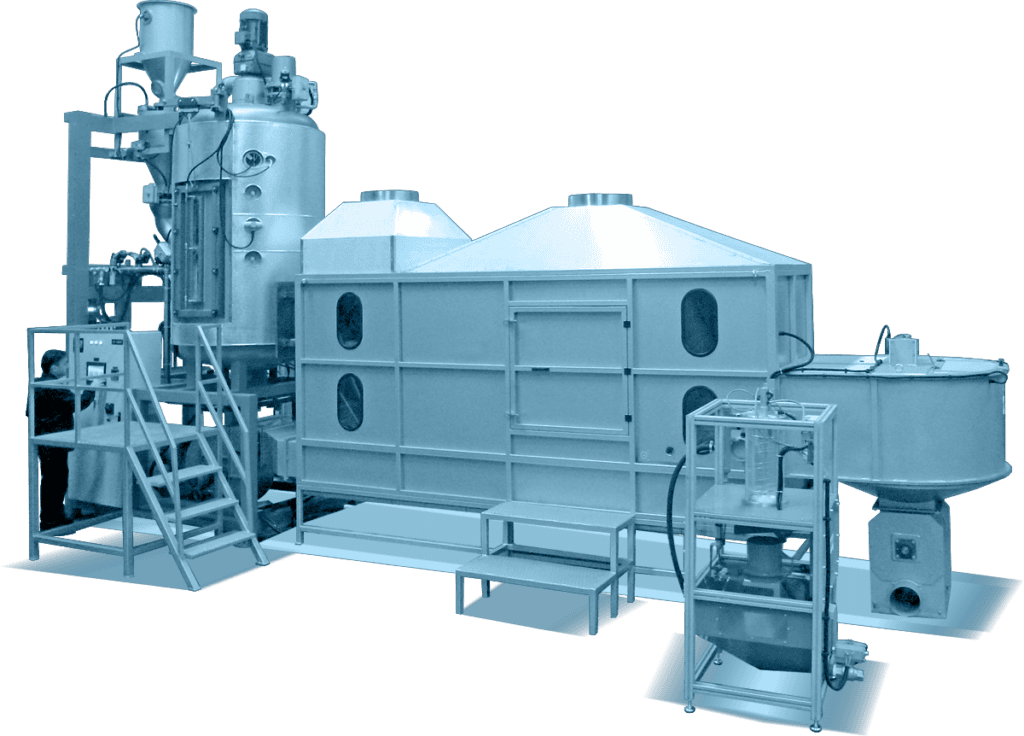
The pre-expander is where density is determined, and density is the single most important variable in EPS product performance.
Target density range for most commercial products is 12-40 kg/m3. Insulation boards typically require 15-25 kg/m3, packaging 20-30 kg/m3, and structural or load-bearing applications 25-35 kg/m3. The pre-expander must hit the target within a narrow tolerance, typically plus or minus 0.5-1.0 kg/m3.
Steam pressure during pre-expansion is normally 0.3-0.6 bar gauge. Too much steam overexpands the beads, producing a density that is too low and cell walls that are too thin. Too little steam results in incomplete expansion and wasted capacity.
Homogeneous expansion means every bead in the batch reaches approximately the same size. This requires uniform steam distribution inside the pre-expander chamber, consistent feed quantities, and a well-calibrated density control system. Batch-to-batch variation should be monitored with automatic weighing after each cycle.
Curing (Aging) Requirements
Freshly expanded beads are not ready for molding. They contain residual moisture and a partial vacuum inside the cells (pentane and steam have condensed, and air has not yet diffused in). Curing corrects both conditions.
Curing duration is 6-24 hours, depending on bead size, density, and ambient conditions. Under-cured beads collapse under vacuum during molding, producing blocks with poor surface quality and internal voids. Over-curing is rarely a problem, but excessively long storage (beyond 48-72 hours) allows continued pentane loss, which reduces fusion quality.
Ventilation around the aging silos is a process requirement as much as a safety measure. Adequate airflow removes moisture from the bead surfaces and accelerates the air diffusion that restores cell pressure. Poorly ventilated silos produce damp beads that require more steam energy during molding and yield products with higher residual moisture.
Moisture control is particularly important in humid climates. If beads arrive at the mold with surface moisture, the steam cycle must first evaporate that water before it can heat the beads to fusion temperature, lengthening cycle time and increasing energy consumption.
Molding Conditions
Whether using a block mold or a shape mold, the molding stage is where individual beads are fused into a solid mass. The quality of fusion determines the mechanical properties and surface finish of the product.
Steam distribution inside the mold must be uniform. Steam enters through perforated plates on opposite sides of the mold, and the pressure differential drives it through the bead bed. Clogged steam ports, damaged gaskets, or uneven condensate drainage all cause localized under-fusion, regions where beads are bonded weakly or not at all.
Steam pressure and timing in the mold are typically controlled in stages: a purge phase (to displace air), a cross-steaming phase (steam from one side, then the other), and a fusion phase (steam from both sides simultaneously). Total steam time for a standard block mold is 30-90 seconds, depending on block thickness and density.
Cooling must remove enough heat for the block to maintain dimensional stability after ejection. Vacuum cooling is standard: a vacuum pump draws air and condensate out of the mold, causing flash evaporation that cools the block rapidly. Insufficient cooling causes post-ejection expansion (the block grows after leaving the mold), which distorts dimensions.
Mold condition matters. Worn seals, corroded surfaces, or damaged steam plates all affect product quality. A preventive maintenance schedule for mold tooling is not optional. It is a quality control measure.
Finished Product Testing
The final check on EPS quality is physical testing of the finished product. The key parameters and their typical test methods are:
Density is measured by cutting a sample of known dimensions, weighing it, and calculating mass per unit volume. For insulation boards, the declared density must be met across the full panel, including edges. Edge-to-edge and top-to-bottom density variation within a single block should be less than 5%.
Compressive strength is tested at 10% deformation per EN 826 or equivalent standards. Typical values range from 60 kPa at 15 kg/m3 to 200 kPa or more at 30 kg/m3. This property is critical for floor insulation, inverted roofs, and geofoam applications where the EPS bears sustained load.
Thermal conductivity is measured with a heat flow meter or guarded hot plate apparatus. Standard white EPS at 15-20 kg/m3 yields values of 0.035-0.040 W/mK. Grey (graphite) EPS achieves 0.030-0.032 W/mK. These values must be met at the declared density. Any density shortfall directly degrades thermal performance.
Bending strength indicates how well the beads are fused. A well-fused block breaks through the beads themselves (intragranular fracture). A poorly fused block breaks between the beads (intergranular fracture), and the fracture surface looks like a cluster of intact spheres. Bending strength for construction-grade EPS is typically 100-250 kPa depending on density.
Dimensional stability is assessed by exposing samples to elevated temperature (typically 70 or 80 degrees Celsius) for 48 hours and measuring any change in length, width, and thickness. Acceptable dimensional change is less than 1% in any direction.
Fire behavior is classified according to regional standards (Euroclass E per EN 13501-1 for standard FR-grade EPS in Europe, for example). EPS raw material is inherently combustible, but fire-retardant grades contain an additive (typically hexabromocyclododecane or a polymeric brominated flame retardant) that causes the material to self-extinguish when the ignition source is removed.
Safety and Environmental Considerations
Pentane emissions during pre-expansion and aging must be managed. Pentane is a volatile organic compound (VOC) and forms explosive mixtures with air at concentrations of 1.4-7.8% by volume. ATEX-rated electrical equipment, continuous gas monitoring, and forced ventilation are standard requirements in the pre-expander and silo areas.
Recycling of production scrap is both an economic and environmental measure. Cutting waste and reject products are ground, de-dusted, and blended back into the process. A well-run factory recycles 100% of its internal scrap.
Worker safety requires attention to noise (grinders and compressors), dust (cutting and grinding operations), and heat (steam systems and mold areas). Personal protective equipment, dust extraction, and machine guarding are baseline requirements, not extras.
Quality in EPS production is not a single checkpoint. It is the sum of controls applied at every stage from raw material receipt to product dispatch. Factories that treat quality as a continuous process produce consistently better material with less waste.