

EPS Vacuum Unit - Dry Cooling
| Specification | Value |
|---|---|
| Cooling Method | Dry - closed-loop heat exchangers |
| Heat Exchangers | Two-stage (primary and secondary) |
| Water Condenser | None - no internal water condensation |
| External Water Circuit | Not required |
| Cooling Tower | Not required |
Key Features
- Closed-loop system with no water condenser or water spray
- Two heat exchangers for staged thermal rejection
- No cooling tower or external water circuit required
- Significantly reduced water consumption versus evaporative systems
- Preferred solution for water-scarce or water-restricted locations
Closed-Loop Dry Cooling
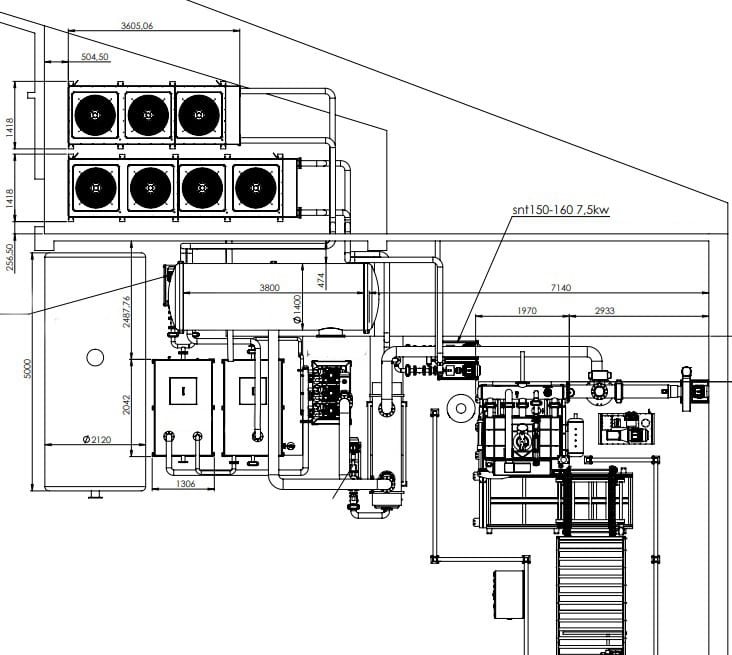
The dry cooling vacuum unit removes residual steam from EPS blocks after fusion without using water-based condensation. Where evaporative systems use an internal water condenser and hydrosphere spray, the dry unit relies on two heat exchangers operating in series to extract thermal energy from the process steam and reject it to the ambient environment. The vacuum function is maintained entirely within a closed loop. No water enters the vacuum circuit, and no external water cooling infrastructure is needed.
Two-Stage Heat Exchanger Design
The system uses a primary heat exchanger to absorb the bulk of the thermal load from the incoming steam drawn out of the block mold. A secondary heat exchanger provides additional cooling capacity and brings the process fluid temperature down to the level required for consistent vacuum performance across repeated cycles. Both exchangers are air-cooled, rejecting heat directly to the surrounding environment without evaporative losses.
This staged approach ensures that the vacuum unit can maintain target pressure levels even during sustained high-cycle-rate production without thermal saturation of a single exchanger.
Eliminated Infrastructure
By removing the water condenser from the vacuum circuit, the dry cooling unit eliminates several supporting systems that evaporative units require: cooling towers, cooling pools, water circulation pumps, water treatment, and makeup water supply lines. The result is a smaller installation footprint, lower civil works cost, and significantly reduced ongoing water consumption.
For facilities in regions where water is scarce, expensive, or subject to discharge regulations, the dry vacuum unit removes a major constraint from block molding operations.
Performance and Trade-Offs
Dry cooling vacuum units deliver equivalent vacuum performance to evaporative systems when properly sized for the block form machine and target cycle rate. The primary trade-off is higher initial equipment cost compared to a standard evaporative unit. However, in locations where water procurement, treatment, and cooling tower maintenance represent significant operating expenses, the total cost of ownership over the machine’s service life often favors the dry system.
Dry units are also simpler to maintain, with no mineral scaling, no biological fouling of cooling water, and no seasonal adjustments for ambient humidity.
Request Dry Cooling Vacuum Unit Specifications
Tell us about your site conditions and production requirements, and we will evaluate whether dry cooling is the right fit for your block molding line.
Get a Quote